Management and Leadership: Are they the Same Thing?

Within the museum and heritage sector, the terms manager and leader are often used interchangeably. Job advertisements, organisational strategies and professional development programmes frequently blur the distinction between the two. Yet while management and leadership can complement one another, they are not the same thing.

As Course Director for GEM's Emerging Leaders Programme, I have noticed that many applicants have either recently stepped into a management role or are actively seeking one. This suggests an assumption that leadership is the natural next step for managers, or perhaps that leadership is simply another aspect of management.
But is that really the case?
Is leadership restricted to those with managerial responsibility? Can leadership exist without authority? Can someone influence the direction of an organisation without holding a senior position?
Before answering those questions, it is worth considering what we actually mean by leadership.
What is Leadership?
Management comes with a degree of formal authority. A manager has seniority within an organisation and is entrusted with responsibility for people, budgets, projects or processes. They have the authority to set priorities, allocate resources and make decisions that others are expected to follow.
Leadership operates differently.
A manager can tell people what to do. A leader gives people a reason to do it.
Leadership is not dependent on a job title, organisational status or line management responsibility. Some of the most effective leaders I have encountered have held no formal authority at all. They commanded respect through their actions, articulated a compelling vision and inspired others to work towards it. People chose to follow them.
That distinction matters. Authority can be assigned, but leadership is granted by others. It is less about position and more about influence. Leadership is, at its heart, a voluntary act.
This is perhaps why leadership can be difficult to define. We often recognise it when we see it, but struggle to describe it in practical terms. We know that some individuals are capable of bringing people together, creating momentum and helping others believe in a shared purpose. Yet these qualities rarely appear in organisational charts.
Multi-Directional Leadership
Most of us have displayed leadership skills at some point, often without recognising it. Leadership occurs whenever we persuade others to support an idea, embrace a change or work towards a shared objective.
Leading a team you manage can be easier because people may already look to you for direction. The real test of leadership often comes when there is no formal authority to rely upon.
When you persuade colleagues to support an initiative, encourage a project group to adopt a different approach, or convince your line manager to back an idea, you are exercising leadership. This is often described as sideways or upwards leadership, and it requires influence rather than authority.
Persuasion is sometimes viewed with suspicion, as though it involves manipulation. Effective persuasion is quite the opposite. It requires empathy, active listening and an understanding of what matters to others.
If we only focus on our own priorities, we risk leaving people behind. Strong leaders take the time to understand the ambitions, concerns and motivations of those around them. They recognise that different perspectives strengthen a team and that sustainable change is only achieved when people feel invested in the outcome.
This is often refered to as trading in other currencies. It's not about seeking consensus but rather highlighting the benefits to others and identifying shared values.
The most successful leaders do not simply convince others to adopt their vision. They shape and present a vision that others can genuinely support.
The Manager-Leader
When museums recruit senior managers, job descriptions tend to focus on managerial responsibilities. There will be references to governance, budgets, performance management and operational delivery. There may be mention of managing teams. References to vision, inspiration or influence are often less prominent.
Yet many organisations expect senior staff to provide both management and leadership.
The strongest senior professionals are usually capable of doing both. They understand the importance of systems, processes and accountability, while also creating a sense of purpose that motivates others. In practice, management and leadership are often intertwined, each strengthening the other.
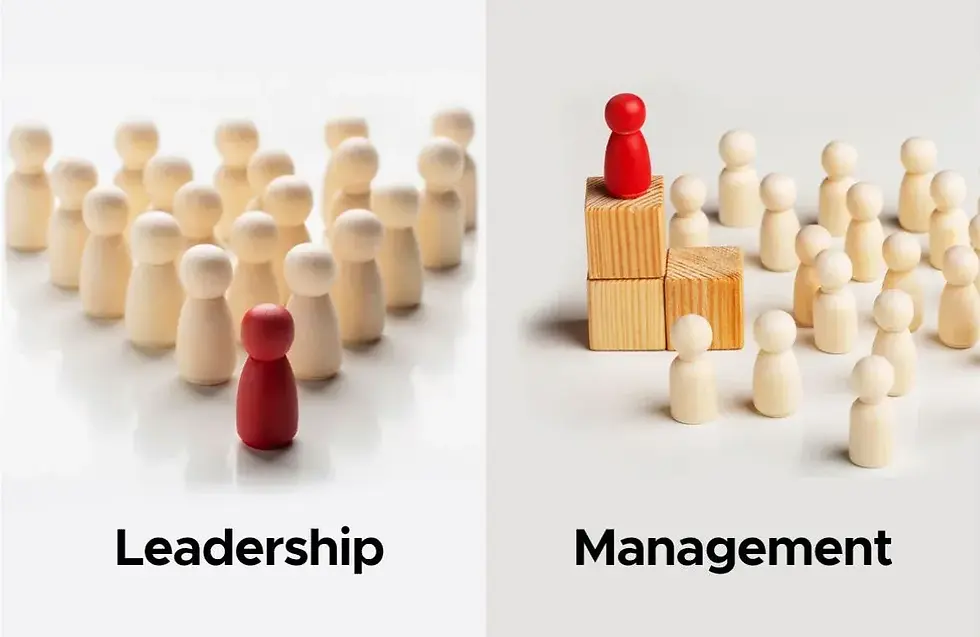
Management remains essential. Organisations need structures that ensure progress is measured, resources are managed effectively and procedures are followed. Without management, even the most inspiring vision can struggle to achieve tangible results.
The challenge comes when we assume that management automatically creates leadership, or that leadership can only be exercised by those with authority.
Perhaps the more interesting question is not whether someone is a manager or a leader, but what experience they create for those around them.
As employees, do we want to be managed or led?
Most of us probably need both.
How should Leadership be measured?
Leadership often becomes easier to identify when we look backwards. We are natural storytellers and tend to judge leadership through outcomes. Success allows us to construct a narrative in which leadership appears obvious and inevitable.
But what happens when the objective is not achieved?
Are we still as willing to recognise leadership when the outcome falls short?

Organisations often place significant emphasis on measurable results, and understandably so. Yet an exclusive focus on outcomes can obscure the behaviours that made progress possible in the first place.
If you inspired those around you, encouraged people to contribute, created a sense of shared purpose and helped others develop, then leadership was present regardless of the final result.
Outcomes matter, but they should not be the sole measure of leadership. The quality of the relationships built, the confidence developed within a team and the culture created along the way are equally important.
The outcome may shape the story we tell afterwards. It should not be the only measure of whether leadership took place.
A Team of Leaders
An effective manager-leader benefits from being surrounded by other leaders. These are the people who inspire colleagues, maintain momentum and ensure that organisational objectives remain relevant when circumstances change.

Leadership should not be concentrated at the top of an organisation. Museums and heritage organisations are at their strongest when leadership is distributed throughout teams, projects and departments. When individuals at every level feel empowered to influence, contribute and advocate for positive change, organisations become more resilient and adaptable.
We need organisations filled with leaders, not simply organisations led by leaders. A team of leaders, not simply a leadership team.
This is why leadership development should not be viewed solely as preparation for promotion.
Leadership programmes are not reserved for those seeking senior positions. They are opportunities to develop skills that help us influence, collaborate and achieve meaningful outcomes, regardless of where we sit within an organisational structure.
Ultimately, we can all be leaders. The question is not whether we hold the authority to lead, but whether we choose to exercise the influence that leadership requires.
If you are interested in developing your leadership skills, or exploring other aspects of personal and professional development, take a look at the courses and opportunities available through GEM.
I look forward to meeting some of you on your leadership journey.
Paul Baker
Links:


From my experience, the failure in all types and sizes of organisations to distinguish clearly between leadership and management is a regular cause of issues in performance, delivery and culture.
Put simply, if management is about doing things right, then leadership is about doing the right things.
Both can, and often have to, coexist in the same role but being clear about which you are doing when is critical.
And as you suggest, leadership can (and in my view should) be distributed across and organisation, whereas management cannot without causing confusion over accountability and responsibility.
In terms of the interface between museums and schools, I think there is a lot to be learned from the evolution of distributed leadership in…